|  | |
Join ARRL Education Specialist Wayne Greene, KB4DSF, on the next On the Air Live as he discusses how to build a rugged 2-meter VHF ground-plane antenna from simple, easy-to-find wire—no exotic parts, no machine shop required. “This isn’t a fragile attic experiment; we’ll design it stout enough for real outdoor duty and then take it a step further with an unconventional deployment method that gets the antenna up to 50+ feet—without a tower," he said. The episode will be live on the ARRL's Learning Center on March 24 at 8 PM Eastern. Preregistration is required and can be accomplished on the Learning Center. 2026 National Hurricane Conference Amateur Radio Workshop -- Amateur radio will be represented at the 2026 National Hurricane Conference to be held at the end of the month in Orlando, Florida. The workshop will be conducted at the conference and livestreamed.The conference theme is improving hurricane preparedness. Two amateur radio sessions will be conducted on Tuesday, March 31st, from 1:30 until 3:15 PM ET and from 3:30 until 5:00 PM. Each presenter will give an overview of their respective group, and specifically how their group responded to the significant hurricanes over the past year. Here is the session breakdown: NHC Session #1 – 1:30-3:15 PM: Bob Robichaud, VE1MBR, from the Canadian Hurricane Centre will present on hurricane meteorological topics and a 2025 hurricane season review. He will speak on Canadian Hurricane Centre operations. National Hurricane Center staff will present an Overview of Amateur Radio Collaboration During Hurricanes. Julio Ripoll, WD4R, will present on hurricane center station WX4NHC operations. Bobby Graves, KB5HAV, manager of the Hurricane Watch Net (HWN), will give an overview of net activity and plans. NHC Session #2 – 3:30-5:00 PM: Rob Macedo, KD1CY, will present on the VoIP Hurricane Net and best practices in SKYWARN for tropical systems. Bill Feist, WB8BZH, and Joe Bassett, W1WCN, will present a SATERN (Salvation Army Team Emergency Radio Network) overview. ARRL Emergency Communicatons and Field Services Director Josh Johnston, KE5MHV, will give an ARRL update. Amateur radio presentations will be recorded and posted to YouTube. They will also be livestreamed on YouTube livestream. |
 | |
SKYWARN Special Event This Month |
Young radio amateurs dedicated to weather spotting, emergency communication, and community education will operate special event station NØA for the next two weeks to promote severe weather awareness. NØA will be operated March 15 – 29 at various times — day and night — as time permits, using SSB, and FT8/FT4 on 80, 40, 20, 17, 15, 12, and 10 meters, as well as FT8 on 160 and 30 meters. For operators without HF access, SKYWARN Youth invites check-ins to their weekly nets on Sundays — March 15, 22, and 29 — at 7:30 PM Central, via multiple repeaters and VoIP networks. All check-ins to those nets will be officially added to the NØA special event log. “Being prepared and establishing situational awareness during severe weather events is crucial and will help you and your family to stay safe,” said SKYWARN Youth Net Manager Caleb Sfair, KEØFOE. “Our goal with this special event station is to educate the amateur radio community about the dangers of severe weather and the importance of being prepared.” All amateur radio operators are encouraged to spread the word and participate in this effort to strengthen weather safety networks worldwide. More information is available. The Pennsylvania Auxiliary Communications Service (PA ACS) was activated to provide “eyes and ears” ground truth snowfall reports during the state’s late January snowstorm. PA ACS members who are registered with SERVPA received a phone call, email, and/or text message from Travis Best, W3TMB, Commonwealth ACS Officer, requesting reports of snowfall amounts and other significant information during the storm. PA ACS activated the Pennsylvania Emergency Management Agency (PEMA) State Emergency Operations Center (SEOC) amateur radio station KB3NIA in Harrisburg. In Centre County, Pennsylvania, the county ACS activated to forward local and regional snow and temperature reports directly to the National Weather Service (NWS) State College Weather Forecast Office (WFO). The county ACS received reports from Huntingdon and Blair counties, in addition to Centre County, which received 7 to 15 inches of snow. The Clearfield County ACS activated Sunday, January 25, to collect local snow reports for county emergency management and to forward to PEMA and the NWS State College WFO.— Blair ARES Alert, March 2026 [newsletter of the Blair County, Pennsylvania ARES program] A Coalition for Readiness: The ARRL Los Angeles Section’s LAXNORTHEAST, the Emcomm Training Organization (ETO), and partners announced the 2026 TSUNAMI Exercise. Amateur radio operators are the backbone of disaster communication, and staying sharp requires realistic, hands-on practice. Supported by a strong partnership between LAXNORTHEAST, ETO, and many more community groups, the 2026 TSUNAMI Exercise is an international drill specifically designed to test and enhance collective capabilities in a simulated, high-stress environment. Rooted deeply in community preparedness, the exercise will walk operators through a severe earthquake and subsequent tsunami/flood warning scenario. Participants will be challenged to complete eight core Winlink tasks, which emphasize precise data entry and the use of standardized ICS forms such as the ICS-214 and ICS-213. - Dates: The exercise window opens March 19, 2026, at 0600 UTC and closes March 30, 2026, at 0600 UTC. Local groups are highly encouraged to pick specific dates within this window to run their nets.
- Exercise ID: Accuracy is paramount! The Exercise ID must be entered exactly as “TSUNAMI” to ensure interoperability with automated mapping systems.
- Get Started: The complete task list and instructions are available now.
A special thank you to the USGS for its fantastic encouragement of this exercise. We look forward to seeing your check-ins on the board! —Oliver Dully, K6OLI, ARRL District Emergency Coordinator, LAXNORTHEAST, Los Angeles, California |
Blizzard of 2026 Leaves a Historic Mark on Southeast New England |
A severe blizzard left its mark on Southeast New England with massive amounts of snow leaving vehicles and even plows stuck in the snow, damaging winds gusts to hurricane force causing ~350,000 customers to lose power in Massachusetts and Rhode Island, and some coastal flooding at the time of high tide. The blizzard broke the state record for snowfall in Rhode Island set by the Blizzard of ‘78 with 37.8” of snow in Providence. ARES-SKYWARN nets across southern New England activated with the WX1BOX amateur radio team to support the NWS Boston/Norton office, local and state emergency management, and broadcast media with timely updates on this historic storm. |
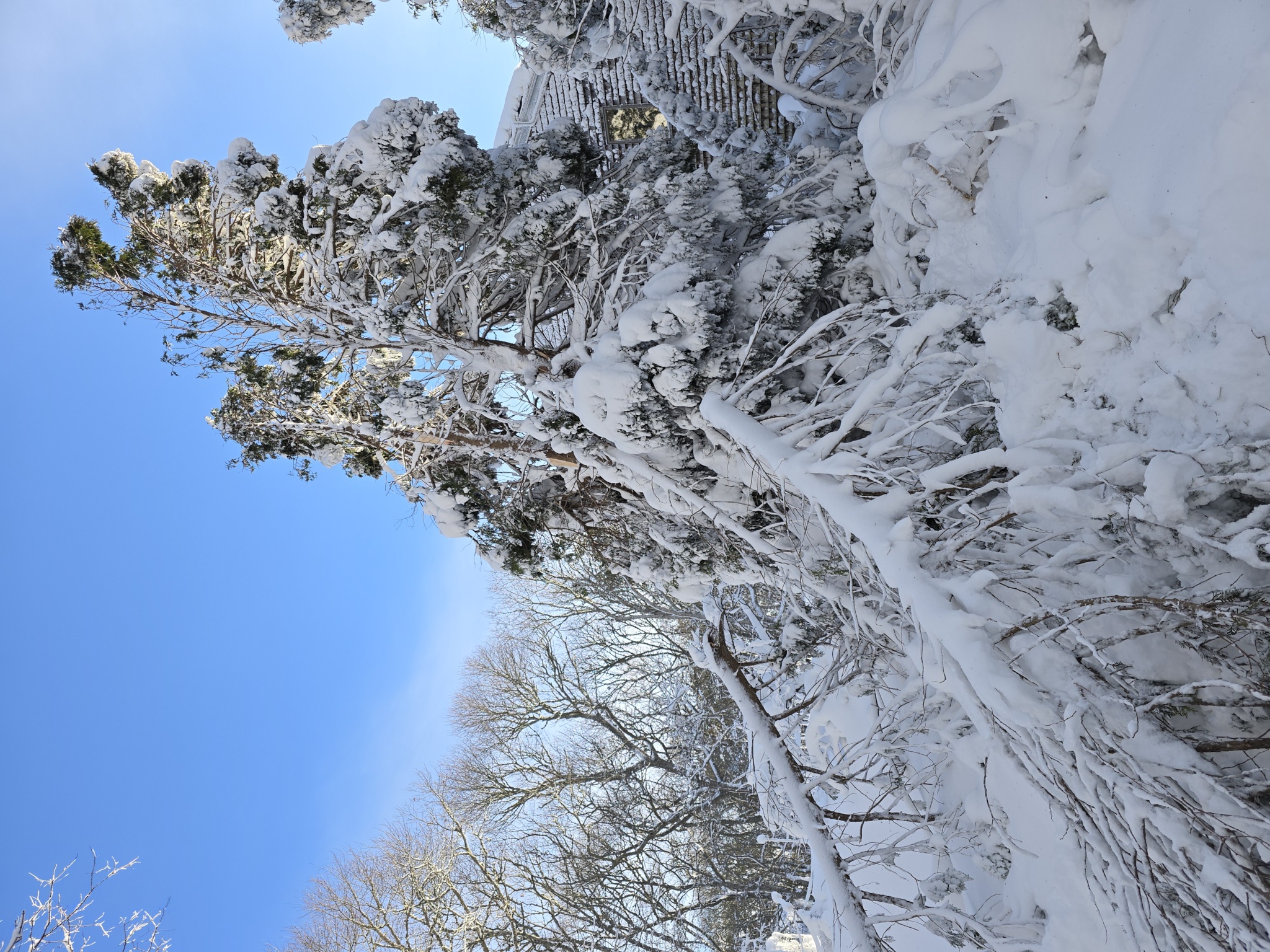 | | West Falmouth, Massachusetts [Photo courtesy of Marinna Martini, W1FX] |
|
|
|
“We had ARES-SKYWARN nets activating on an every 1-2 hour basis, providing snowfall, wind gust, wind damage and coastal flood reports,” said Rob Macedo, KD1CY, Eastern Massachusetts ARES Section Emergency Coordinator and SKYWARN Coordinator. “The nets were very active with great participation allowing a comprehensive situational awareness view for NWS, emergency management and the media. We also interacted with many non-amateur radio SKYWARN spotters via social media.” Reports of snowfall as high as 3 feet as well as 43” in Tiverton, Rhode Island, and 41” in Fall River, Massachusetts, were received from amateur radio and non-amateur radio SKYWARN spotters. Macedo said his hometown of New Bedford recorded 37” of snow. “At least a half dozen amateur radio and non-amateur radio SKYWARN spotters reported snowfall totals in the city of New Bedford anywhere from 32.5” to 37”, Macedo said. Amateur radio SKYWARN nets were active on over a dozen repeaters across southern New England along with the New England amateur radio VoIP reflector system, with snowfall, wind damage and wind gust reports. The Amateur Radio Net plan for Massachusetts was sent into Massachusetts Emergency Management in an ICS-205 to ESF-2 as part of a closer working relationship with state emergency management. Well over 1,000 reports were generated from these nets and shared with partner agencies and the media. Blizzard conditions were met at numerous sites across southern New England. Eastern Massachusetts ARRL Section Eastern Massachusetts ARES was placed on stand-by on Sunday February 22 for any partner agencies and to augment and enhance support for the ARES-SKYWARN nets for participation. Eight different amateur service repeaters had rolling nets on an hourly to two-hourly basis reporting the rapidly accumulating snowfall as high as 4-5” per hour resulting in snow accumulations of 1-3 feet with isolated higher amounts, storm damage from the combination of wet snow and strong to damaging wind gusts, including some beyond hurricane force. Several hundred reports were generated from the nets. ARES coordinators and net controllers staffed the nets for over 18 hours, including Terry Stader, KA8SCP; Stu Solomon, W1SHS; Don Rolph, AB1PH; Tom Ulrich, KC1OCY; Jim Palmer, KB1KQW; Patrick Mannion, W1PAC; Phil McNamara, N1XTB; Jeff Lehmann, AJ1L; Frank O’Laughlin, WQ1O; along with several other net controls. In addition to the ARES-SKYWARN activity, Cape Cod ARES members Chris Ranney, WA1CMR, and Dennis Driscoll, N1DRN, deployed to support operations in the town of Sandwich, Massachusetts, providing auxiliary communications between their EOC and the shelter for the town. Rhode Island ARRL Section Through the efforts of Rhode Island SKYWARN Coordinator Wayne Burkett Sr., KA1VRF, and Bill Boyes, KB1G, Rhode Island SKYWARN stood up nets on the NB1RI Rhode Island statewide linked repeater system for over an 18 hour period, including during the overnight period Sunday, February 22, through Monday morning. Reports were of downed trees and power lines, and rapidly accumulating snow 4-5” per hour that had up to 3 feet of snow with isolated higher amounts. Despite Rhode Island being a small state, several hundred reports were generated via their nets. Connecticut ARRL Section Through the efforts of Roger Jeanfaivre, K1PAI, and Mary Duval, K1MTD, the 146.79 MHz Vernon repeater provided ARES-SKYWARN net coverage across Hartford, Tolland, and Windham Counties with over a half dozen nets and more than 100 reports of snowfall received with 1-2 feet of snow and some reports of damage between wet snow and strong to damaging wind gusts in the northeast region of the state. Western Massachusetts ARRL Section ARES-SKYWARN Net Coordinators and net control stations Charlie “Smitty” Smith, KC1IKA; Ez Moralez, W1AE; Bob Meneguzzo, K1YO, and Rich Laviolette, KC1AEO, ran nets every two hours Sunday evening and all day Monday. Al Giguere Jr., KB1VNH, also supported efforts with spotter reports during the nets. Over a hundred reports were generated with 6-12” of snow and isolated higher amounts reported along with some pockets of tree and power line damage and power outages. Amateur radio received media attention on The Weather Channel several times throughout the blizzard. Reporter Jim Cantore stated, “When we get all these observations, it comes from SKYWARN spotters and amateur radio operators because when people can’t communicate and the phone lines are down, the amateur radio operators are all we got.” The WX1BOX web site has been updated with a Post Blizzard Coordination Message. One more update may be provided by the end of March or early April. —Rob Macedo, KD1CY, ARRL Eastern Massachusetts Section Emergency Coordinator and SKYWARN Coordinator |
Amateur Radio Operators at the Honolulu EOC During Severe Weather Activation |
On February 8–9, 2026, severe weather brought high winds, heavy rainfall, flash flooding, power outages, and hazardous surf conditions across Honolulu and the State of Hawaiʻi. Both Governor Josh Green and Honolulu Mayor Rick Blangiardi issued emergency proclamations to mobilize resources and protect public safety. Amateur radio operators were activated inside the EOC in support of the Department of Emergency Management (DEM), City and County of Honolulu. Volunteer communicators reported in and stood ready to provide backup communications should cellular or internet systems fail. The amateurs participated in county and statewide briefings with Governor Green, Maj. Gen. Stephen Logan, and Hawaii Emergency Management Agency (HI-EMA) leadership. They joined statewide HF nets at 9:00 AM, 12:00 PM, and 4:00 PM on 7.090 MHz (LSB). Hams updated and posted the ICS-205 Communications Plan on HawaiiARES.net for download and offline reference. They logged activity in the ICS-214 Unit Log. They also operated at KH6OCD on HF and VHF/UHF voice, monitored repeaters, and utilized Winlink radio email on HF and VHF FM. Radio traffic remained light as outages were quickly addressed through coordinated efforts between city and state agencies, and utility partners. Shelters and volunteers remained ready in case conditions worsened. Emergency Management Reserve Corps (EMRC) The Emergency Management Reserve Corps (EMRC) supports the community through trained volunteers who serve either in field operations across Oʻahu or as amateur radio communicators under RACES. Most RACES members are also active in ARES, strengthening coordination between county and statewide response efforts. Deputy RACES Coordinator Michael Miller, KH6ML said: “It was encouraging to work alongside such engaged and supportive leadership from the Department (of Emergency Management). Dr. Randal Collins, Director, and Jennifer Walter, Deputy Director, along with Douglas Tom and Jeff Spencer, clearly understand how amateur radio strengthens resiliency and provides independent communications capability. Their awareness of our role in a larger grey or black sky event ensures RACES remains fully integrated into emergency operations.” Operations and Coordination RACES Coordinator Mark Kaku, KH6LT, coordinated amateur radio operations inside the EOC, ensuring continuous coverage throughout the activation. He said, “Our goal is simple—be ready before we’re needed. We focus on coverage, documentation, and coordination so that if primary systems fail, we can immediately step in.” Prepared and Ready Systems were tested, nets were active, and documentation was completed. The activation reinforced the value of having trained, infrastructure-independent, amateur radio communicators embedded within emergency management operations. “Mahalo to all who staffed the EOC and supported from across the islands.” --Michael C. Miller, KH6ML, Deputy Coordinator, Radio Amateur Civil Emergency Services (RACES), Department of Emergency Management, City and County of Honolulu; ARRL Assistant Section Manager, Pacific Section |
Washington State Ham Receives Search and Rescue Award |
Yakima County (Washington) Search and Rescue (SAR) recognized Jo Whitney, KA7LJQ, with with an appreciation plaque by the county in recognition of 35 years of dedication to the county’s search and rescue organization. Whitney was licensed in 1981, using her license to give back to the community by joining Yakima County Emergency Management as part of the local ARES group, and then Yakima SAR. In 1991, she took over as ARES EC for Yakima County and has held the role ever since. She logged more hours driving and operating the county mobile command post (MCP) than any other SAR volunteer. She regularly staffs the Rescue Coordination Center and is active in the SAR council that meets every month. Whitney provides training and helps with the yearly SAR academy, both in the classroom, and in the field. She is a member of the ARRL Diamond Club, and Maxim Society. Scott Mitseff, KJ7AVQ, said “one of the things I admired most about Whitney was that she was never too busy to help someone; whether answering a question, programming a radio, or offering a piece of advice, she always treated people with kindness and professionalism.” |
 | |
Simple, Focused, Effective SETs |
Many Emergency Coordinators and emergency managers find that writing and executing a Simulated Emergency Test (SET) is a daunting undertaking. The ARRL West Central Florida Section is fortunate to have Chuck Johnston, W4CWJ, who has written several SETs and participated in emergency communications activities in Florida and other states. Recently, an SET scenario consisted of a cascading power outage throughout the State of Florida, resulting in the loss of all primary, alternate, and contingency communications capabilities. Under the scenario, our 10 counties and several volunteer organizations assisting in disasters (VOADs) participated. For added interest, the theme of the SET was not announced until the night before. Dark Start was written to accomplish several section goals. Initially, we needed to validate the MOU between the ARRL West Central Florida Section and the owners of the multi-county NI4CE repeater system. This agreement allows us to communicate with all ten counties in the West Central Florida (WCF) Section. All counties can send and receive transmissions directly from an Area Command center. This not only facilitates information arriving in a timely manner, it avoids relaying information and possible miscommunications. Our SET scenario involved a cascading blackout caused by a fire at a transformer station. The NI4CE system executed a roll-call for all counties. Each county then returned to their own county system to activate their ARES group, and report back to the Area Command Center using the NI4CE system. Each county was tasked with reporting the number of individuals participating, how many could operate on emergency power and how many were willing to deploy. Although it was a simple drill, it was very effective in pointing out areas that needed fortification before an emergency arose. Our second goal, since emergencies are not regular occurrences and many ARES groups seldom experience emergency activation, was to provide ARES members with needed training and review to keep skills and procedures already learned fresh. SETs also introduce new members to the ARES environment. This SET was simple to create and execute while reviewing valuable lessons of importance and possibly lifesaving knowledge. Another objective was building familiarity and expertise between ARES groups and key management positions during emergency conditions. During the SET several of our Section’s ECs gathered at the Desoto County Emergency Operations Center and formed the Peace River Coordinating Group. The group included several Emergency Management directors and VOAD members who joined to observe the exercise. During a hot wash immediately following the SET, several members expressed concerns about ham speak: many from the coordinating group advocated instead for plain-talk. ECs and other ARES leaders were asked for plans and protocols for contacting ARES groups for sudden activation. Another question arose about communications with CERT groups: many use GMRS radios. How they can be used to a greater extent in emergencies was a topic of discussion. The aim of any SET is to practice emergency procedures and test operators and equipment. All west central Florida counties took part and reported their members were excited to participate. Many of the problems discovered have already been addressed and corrected. Those who participated in the Peace River Coordinating Group were very pleased with the exercise. Seeing how ARES works and what benefits it can bring them during emergencies gave the group new appreciation for ARES and how it can be a valuable part of the emergency team on those “dark sky days.” --Christine Duez, K4KJN, EC, Polk County, Florida |
 | |
National Traffic System Update, Traffic Handler Resources |
The ARRL National Traffic System® (NTS®) is an important network of amateur radio operators who move information during disasters and other emergencies. General messages offering wellwishes also move through the NTS® to help test the system and to help amateur radio operators build traffic handling skills. While the NTS® is primarily set up to serve the United States and Canada, it is possible to move traffic internationally through the NTS® via various local, regional, area, and international network connections. Modernization of NTS (The NTS 2.0 Project) The current National Traffic System (NTS) is comprised of dedicated operators well trained and practiced in the art of traffic handling. They participate in nets at the local, section, region, and area levels 365 days per year. Yet we cannot ignore reality: the proliferation of low-cost/free telephone calls, text messaging, and the worldwide web means today's general public has many alternatives to traditional radiograms. As a result, much of today's NTS traffic consists solely of amateur-to-amateur messages: "welcome to amateur radio," "license expiration," etc. In addition, there are serious questions as to the accuracy and reliability of our networks. Finally, it should be noted that some public agencies have never heard of NTS; or, have begun creating their own backup messaging systems. Historically, NTS and ARES were two branches of the old ARPSC, the Amateur Radio Public Service Corps. While the ARPSC is gone, the two branches remain tied together and serve in a symbiotic way. For more information regarding the modernization of NTS visit The NTS 2.0 Project webpage. To find an NTS-affiliated net in your area, please see the ARRL Net Directory. Sign up to receive The NTS® Letter. The NTS Letter is published monthly and is free of charge to ARRL members. Members can subscribe to the NTS Letter. Other NTS Resources NTS 2.0 NTS Manual NTS Methods and Practices Guidelines Handling Instructions [From The NTS® Letter, Marcia Forde KW1U, Editor, and courtesy of ARRL.] You can find NTS-affiliated nets in your area. |
The Amateur Radio Emergency Service® (ARES) consists of licensed amateurs who have voluntarily registered their qualifications and equipment with their local ARES leadership, for communications duty in the public service when disaster strikes. Every licensed amateur, regardless of membership in ARRL or any other local or national organization is eligible to apply for membership in ARES. Training may be required or desired to participate fully in ARES. Please inquire at the local level for specific information. Because ARES is an amateur radio program, only licensed radio amateurs are eligible for membership. The possession of emergency-powered equipment is desirable, but is not a requirement for membership. How to Get Involved in ARES: Fill out the ARES Registration form and submit it to your local Emergency Coordinator. |
ARES® is a program of ARRL The National Association for Amateur Radio®. No other organization works harder than ARRL to promote and protect amateur radio! ARRL members enjoy many benefits and services including digital magazines, e-newsletters, online learning (learn.arrl.org), and technical support. Membership also supports programs for radio clubs, on-air contests, Logbook of The World®, ARRL Field Day, and the all-volunteer ARRL Field Organization. Join ARRL or renew today! www.arrl.org/join The ARES Letter is free of charge to ARRL members. Subscribe: www.arrl.org/subscribe Find ARRL on Facebook, Instagram, YouTube, X (@arrl and @arrl_ares), and Threads ARRL Store: www.arrl.org/shop Support programs not funded by member dues at www.arrl.org/donate Contact us to advertise in this newsletter (space subject to availability): ads@arrl.org |
The ARES Letter is published on the third Wednesday of each month. ARRL members may subscribe at no cost or unsubscribe by editing their Member Data Page at www.arrl.org/opt-in-out. Copyright © 2026 American Radio Relay League, Incorporated. Use and distribution of this publication, or any portion thereof, is permitted for non-commercial or educational purposes, with attribution. All other purposes require written permission. |
|
|
| |
|
|
|


Comments
Post a Comment