| Solar Eclipses: What the Bands Revealed… |
What effect does a solar eclipse have on HF propagation? That was the basic question posed by researchers enlisting ham radio operators’ help during three Solar Eclipse QSO Parties in the last 10 years. The results of that research were presented at the 2026 HamSCI Workshop, held earlier this month in Connecticut and hosted by ARRL. Data was collected based on spots on the Reverse Beacon Network (RBN), WSPRNet, and PSKReporter during total solar eclipses in 2017 and 2024, as well as an annular (partial) eclipse in 2023. In the 2024 eclipse, there was a drop in the number of contacts on 21 MHz as the eclipse neared totality, while there was an increase in the number of QSOs recorded on 14 MHz. The 30-meter band opened earlier than usual; and 40 meters opened earlier than usual for transatlantic contacts, faded out, and then opened up again. Researcher Kuldeep Pandey of the New Jersey Institute of Technology concluded that effects of the eclipse crossed over with the sunset terminator, accounting for the second opening on 40. Effects on 80 and 160 meters were unclear, as only a few stations were active on those bands during the eclipse. It was also noted that there were differences in results between 2017 and 2024, attributed to different phases of Solar Cycle 25 (2017 was relatively early in the cycle; 2024 was at its peak). |
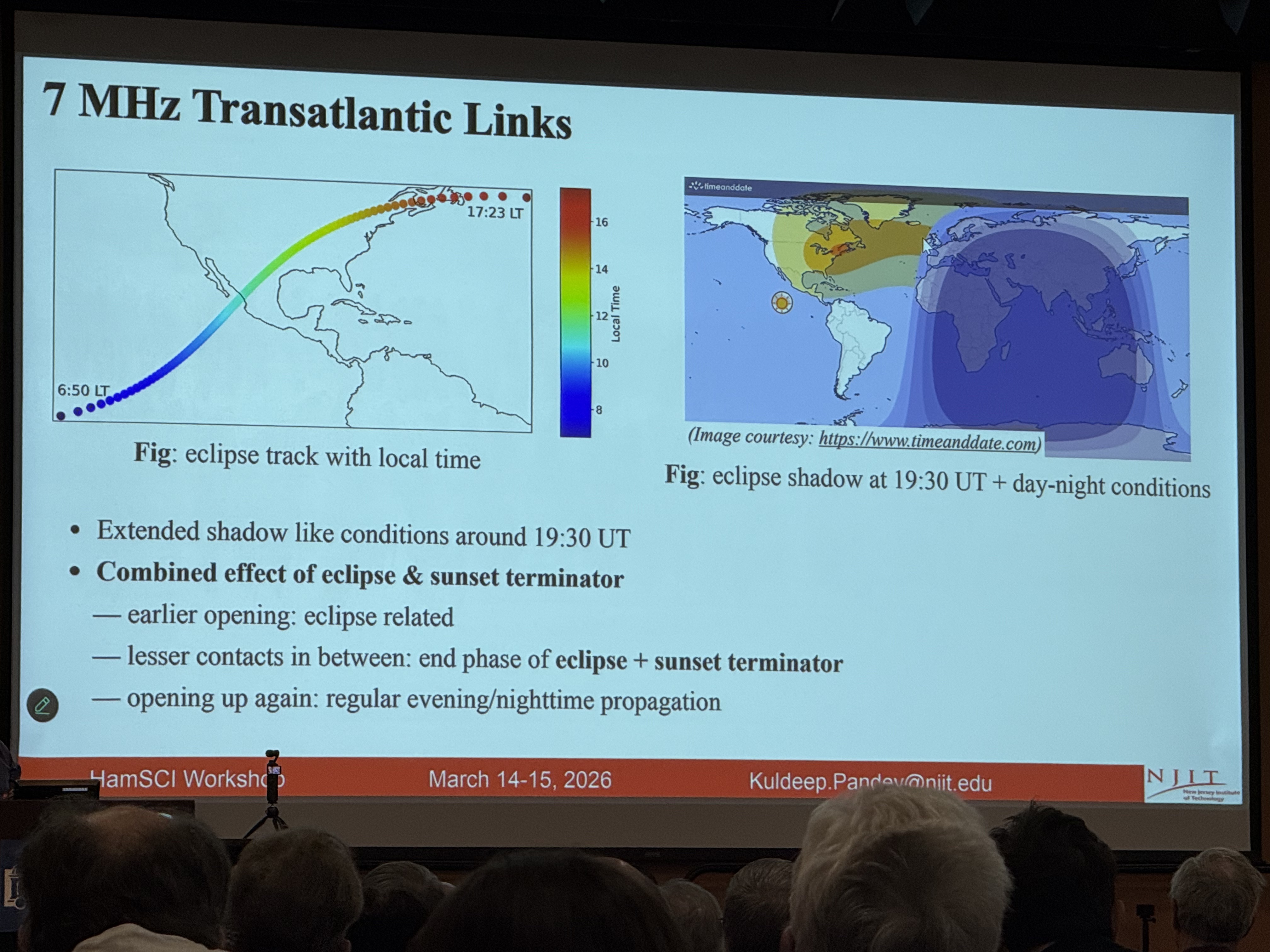 | | Slide illustrating the combined effects of the 2024 solar eclipse and sunset on transatlantic contacts on 40 meters. [Photo by Rich Moseson, W2VU; slide by Kuldeep Pandey, NJIT] |
|
|
|
A Unique Learning Experience for Amateur Radio |
Many current amateur radio operators were attracted to the hobby by the “aromas” emanating from their Elmer’s ham shack, from the slight smell of dust burning on red-hot final tubes, to the more pleasant smell of a hot soldering iron. For the past five years, the Andrew Johnson Amateur Radio Club’s Wednesday Nights Technology program, at the Greene County Makerspace in Greeneville, Tennessee, has been helping students explore a unique introduction to amateur radio....with a little solder smoke! Recently, the students completed a two-month build project for the SolderSmoke Direct Conversion Receivers Challenge. It’s one of the many projects made possible by an ARRL grant. The students, some whom are not yet licensed, took on a challenge to individually construct, solder, test, and then troubleshoot their receivers, all the while learning about the basics of a radio receiver and the related test questions associated with gaining an amateur radio license. ARRL member Steven Bible, N7HPR, has been the lead trainer and wrote the narrative for the project. “The ARRL grant allowed us to purchase equipment and projects so we could create a science, technology, engineering, and mathematics (STEM) curriculum,” said Bible. “Over the past three years, upwards of two dozen students have participated in the program and 50% have received their amateur licenses.” Bible added there was often a “WOW” moment when the students realized what they could accomplish on their own time at their own pace. |
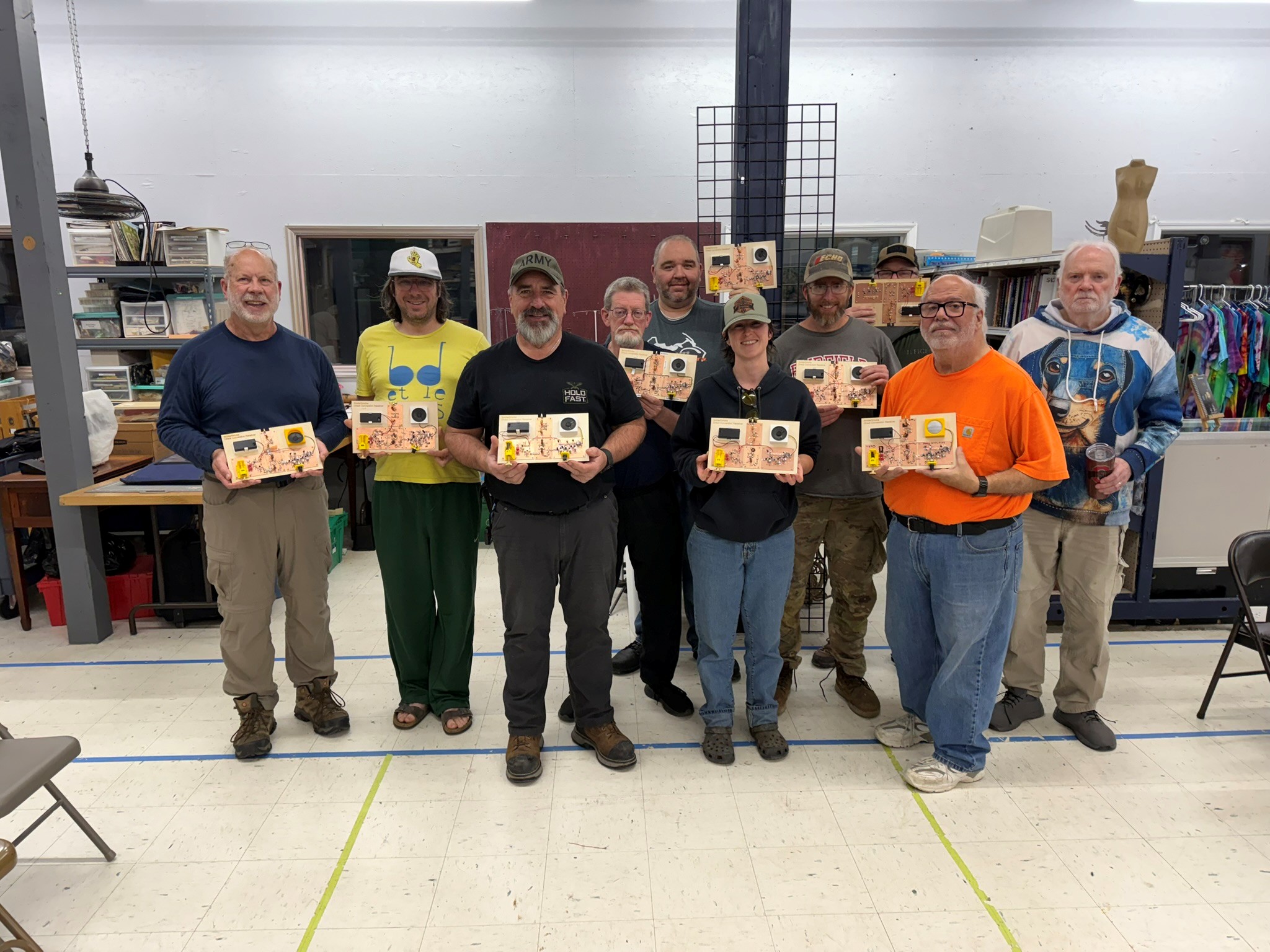 | | Pictured (left to right): Steven Bible, N7HPR, instructor; Clark Blumenstein; Kurt Bessler, KQ4ZHO; Brian Thacker, KQ4OBR; Justin Wilhoit, KR4CUF; Amanda Joly; David Joly; Jamie Nealy, KM4AED; Larry Whiteside, KN4MVH, and Dick Merrill, N5GVW. [Photo courtesy of Steven Bible, N7HPR] |
|
|
|
Using the narrative that Bible wrote, he now wants to expand and begin teaching the trainers how to administer the program to create more opportunities for youngsters and older adults as well. “This spider-like approach will allow for more opportunities to understand the technology.” Bible also said there are more opportunities at the nearby Walters State Community College and their HAMtastic Radio Technology Camps set for June 2026. Andrew Johnson Amateur Radio Club is an ARRL Affiliated Club. During this ARRL Year of the Club, send us stories and photos about the innovative and creative activities of your radio club. Email news@arrl.org. |
Sci-Tech ARS Girl Scouts “First Contact” Event |
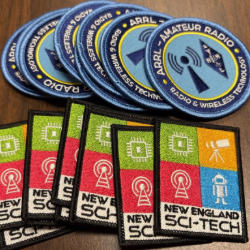
| ARRL and Sci-Tech patches received by all scouts who attended the First Contact event. [Photo courtesy of ARRL New England Division Vice Director Phil Temples, K9HI] |
|
|
The Sci-Tech Amateur Radio Society (STARS) in Natick, Massachusetts, recently hosted a Girl Scout troop from Melrose, Massachusetts, for a “First Contact” opportunity to learn about amateur radio. New England Sci-Tech is a non-profit STEM (science, technology, engineering, and math) education center and maker space dedicated to project-based, hands-on learning for youth and families across New England. The instructors from Sci-Tech included Barbara Irby, KC1KGS; Jocelyn (waiting to take her test); Seth Kendall, KC1PZY; Max Kendall, WØMXX; Brad Moore, KC1TUY; Zachary Sherman, KC1NXK; and lead organizer and instructor Bob Phinney, K5TEC. In the first of many activities, the scouts got to hold a meteorite from an asteroid and one from the moon, discuss earth-to-space communications, then watch a three-minute ARRL video about ham radio. Barbara Irby then talked about ways girls can get involved with ham radio and become a young lady (YL) licensed amateur operator. Jocelyn, a young student waiting to take her license exam, gave an insightful and encouraging talk about her journey to get a radio license with suggestions to the scouts for success. Then it was on to a two-minute video about the workshop where ham radio is highlighted with high-altitude weather balloon launches, followed by a foxhunt with Seth Kendall, who showed off his homemade Yagi antenna that helped the girls find the hidden transmitter. The final activities had the scouts in the radio room where they listened to contacts made with Astronaut Bob Hines on the International Space Station (ISS). Then the girls lined up at the HF station where they all got to make a contact with a YL named Jessica James, KJ5NSH, in Oklahoma. “Events like this are vitally important for the hobby,” said ARRL New England Division Vice Director Phil Temples, K9HI. “To be able to reach out to young girls and put them in contact with mentors who are licensed amateur radio operators, is just a great opportunity.” STARS Secretary and lead organizer Bob Phinney, K5TEC, noted that at the end of the event, the scouts each got an ARRL “First Contact Award” certificate. They were also thrilled to receive an ARRL radio patch and a Sci-Tech logo patch. Fun was had by all...and lots of learning, too. Phinney also encourages scout leaders to get their troops involved in amateur radio because it can become a lifetime of activities and lead to a lifelong hobby. For more information and activities visit New England Sci-Tech. Visit the ARRL website for more information about the ARRL Radio and Wireless Technology Patch Program and for Amateur Radio and Scouting resources. |
 | |
FCC Warns Licensee on Out-of-Band Transmissions |
The Federal Communications Commission (FCC) has responded to a complaint involving a Pittsburgh, Pennsylvania, amateur for operating outside the privileges of his Technician Class license and causing interference to local emergency service communications by transmitting on a public service frequency, 470.4375 MHz. According to a letter released by the FCC’s Enforcement Bureau, agents investigating an interference complaint from Allegheny County Emergency Services determined that the interfering signal originated from the residence of David Knudtson, KD3ASC, who also holds a General Mobile Radio Service (GMRS) license, WSDQ885. The letter states that Knudtson gave the agents a BTech UV-Pro handheld which had been programmed to monitor the county emergency services frequency. Agents determined that its “Audio Relay” feature had been activated, turning the HT “into a simplex repeater that was retransmitting the Allegheny County channel.” The letter continues that Knudtson, who is a relatively new amateur licensee, surrendered the radio to the agents, who then “verified that the interference to the Allegheny County system had ceased.” The letter also notes that Knudtson’s BTech radio was certified as a Part 90 (private land mobile radio) device and that he was not licensed to transmit on the emergency services frequency. Knudtson was warned that unauthorized operation and its associated harmful interference must not resume. He was given 10 days from the date of the March 25 letter to respond with a description of the steps he is taking to avoid a repeat violation. Amateurs are reminded to exercise care when programming non-amateur frequencies into their VHF/UHF radios, and to ensure that transmitting on those frequencies is disabled. |
 | |
ARRL Live Events and Podcasts |
On the Air LIVE Join ARRL's Education Specialist Wayne Greene, KB4DSF, as he discusses and demonstrates how to use Software Defined Radios. Whether you are curious about using the SDR to explore the RF spectrum or looking to integrate them into your home station, this session will break down the basics and show you how to get started. He will demonstrate how to monitor the amateur bands, air band, and some very interesting things you can monitor on the HF bands. You can catch On the Air Live on the ARRL's learning center, learn.arrl.org, on April 28th, at 8pm Eastern. Pre-registration is required and can be accomplished on the Learning Center. 📅 Date: April 28, 2026 🕗 Time: 8 PM Eastern / 5 PM Pacific 👉 Register Now | ⏪ Previously Recorded Sessions |
 | |
ARRL Audio News Listen to ARRL Audio News, available every Friday. ARRL Audio News is a summary of the week's top news stories in the world of amateur radio and ARRL, along with interviews and other features. More info | Listen on Blubrry | Also available on iTunes and Apple Podcasts. |
On the Air Sponsored by Icom Build a 2-Meter Ground Plane with OTA and OTA Live ARRL Education Specialist — and host of On the Air Live — Wayne Greene, KB4DSF, joins the podcast to explain the merits of the antenna presented in his March/April 2026 On the Air article “Building and Installing a 2-Meter Ground-Plane Antenna,” and details how to register for the March 24 On the Air Live session in which he’ll take real-time questions about the construction and use of the antenna. More info | Listen on Blubrry | Also available on iTunes and Apple Podcasts. |
The following America250 W1AW Portable Activations begin 0000z on Wednesdays, and end 2359z on Tuesdays (7 days total for each activation). See the complete schedule at www.arrl.org/america250-was. 03/25/2026 North Dakota W1AW/0 (host W0ND) 04/01/2026 California W1AW/6 (host NZ6Q) 04/01/2026 Mississippi W1AW/5 (host W5UE) 04/01/2026 North Carolina W1AW/4 (host N4XI) |
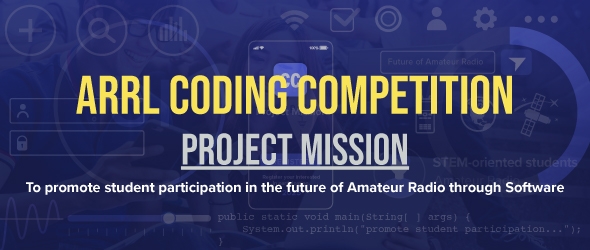
The deadline for completed projects for the ARRL Student Coding Competition is Tuesday, March 31, 2026. The competition, which began on January 1, challenges young amateur radio licensees to create a mobile app that ARRL can build on to offer to members, with appropriate attribution. A winning entry will be awarded a prize of up to $25,000. Visit coding.arrl.org for details. |
The South Carolina-based York County Amateur Radio Society (YCARS) recently completed its 4th consecutive successful food drive, and collected $2,750 to benefit those in need in their local community. John Gendron, NJ4Z, ARRL South Carolina Section Manager and YCARS club member, said that over the past three years club collections have increased from $1000 to more than $2700, all from club members. “We are oldest amateur radio club continuously operating in South Carolina, with 150 members who work hard to help the community,” said Gendron. “With the help of the Covenant Presbyterian Church, we are able to keep their kitchen supplied for at least 6 months to help feed everyone who is hungry.” Grendon added that over 1,000 people have taken advantage of the club’s food drive program. YCARS, an ARRL Affiliated Club, is the featured club in the April 2026 issue of QST and appeared in the “Club Station” column of QST in September 2022. |
The Intercontinental Amateur Traffic Net (Intercon) is seeking additional net control stations to staff open slots in the mornings, or as occasional relief operators. The net operates every morning 0700 - 1200 noon Eastern Time on 14.300 MHz. Net control stations work 1-hour shifts. The Intercon net was formed in 1960 to promote goodwill and friendly relations among radio operators everywhere. The net handles third-party traffic and provides emergency communications to any station when needed, and offers operator training and improvement programs to its members. The Maritime Mobile Service Net (a different organization) takes over on the same frequency at noon Eastern time. They share their proprietary logging program with the Intercon Net. All licensed General Class (or above) amateur radio operators are welcome to check in. Visit interconnet.us for more information. |
Open Positions at ARRL Come join the headquarters staff of ARRL The National Association for Amateur Radio®! We are currently seeking qualified applicants for the following positions: W1AW Station Manager Awards Program Supervisor Development Associate Membership Manager RFI Lab Engineer Public Relations and Outreach Manager Full details may be found on the ARRL HR web page at www.arrl.org/careers. ARRL is an equal opportunity employer. |
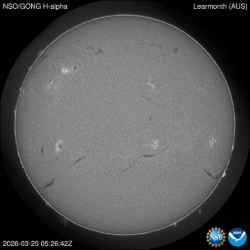
| New solar disk image courtesy of the Learmonth Solar Observatory, March 26, 2026 |
|
|
ARRL Solar Report for March 26, 2026 Solar activity was at low levels with seven numbered active regions on the disk. The largest event of the period was a C3.7 flare on March 25 from Region 4400. Region 4403, which was numbered last period, is the suspected source of several flares observed beyond the limb prior to its rotation onto the disk. Due to its proximity to the northeast limb, foreshortening continues to prevent a definitive characterization of its complexity and extent. The remaining disk regions exhibited varying degrees of decay and evolution. Region 4397 has dissipated into a small unipolar group, while Region 4398 underwent penumbral decay. Region 4399 remained largely stable, though it continues to fluctuate between a unipolar and bipolar state due to the short-lived trailing spots. Significant internal changes were noted in the more complex groups: Region 4400 experienced extensive reconfiguration and flux emergence, and gained a gamma configuration. Similarly, Region 4401 exhibited persistent flux emergence and an expansion of penumbral area in its trailing spots. Region 4402 showed a decline in its leader spot cluster. No Earth-directed coronal mass ejections (CMEs) were observed in available coronagraph imagery. Solar activity is expected to be low with a chance for M-class (R1-R2/minor-moderate) flares through March 28. Solar Wind Update For the first several hours of the reporting period, solar wind parameters reflected the continued waning influence of a negative polarity coronal hole high-speed stream (-CH HSS). During this time, solar wind speed decreased from approximately 550 km/s to 515 km/s. On March 25, a transient CME began its passage through the near-Earth environment. accompanied by a rise in solar wind speed to a peak of 633 km/s. Solar wind parameters are expected to remain mildly enhanced as current influences diminish. Additional enhancements are anticipated on March 26, following the arrival of another component of the March 22 CME. Following this passage, a gradual return to a nominal, slow-speed regime is forecast through March 28. The 10.7-centimeter flux: March 26, 125; March 27, 130; March 28, 130; March 29, 128; March 30 – 31, 125; April 1, 130. Predicted sunspot numbers: March 26, 115; March 27, 110; March 28, 120; March 29, 106; March 30, 126; March 31, 103; April 1, 129. For more information concerning radio propagation, visit the ARRL Technical Information Service, read A Quick Guide to HF Propagation Using Solar Indices, and check out the Propagation Page of Carl Luetzelschwab, K9LA. For customizable propagation charts, visit the VOACAP Online for Ham Radio website. |
 | |
- March 27 - 28 -- Sasquatch Stomp (CW)
- March 28 - 29 -- CQ WW WPX Contest SSB (phone)
- March 28 - 29 -- Africa All Mode International DX Contest (CW, phone, digital)
- April 2 - 3 -- Walk for the Bacon QRP Contest (CW)
- April 4 - 5 -- YBDXPI SSB Contest (phone)
- April 4 - 5 -- EA RTTY Contest (digital)
- April 4 - 5 -- Louisiana QSO Party (CW, phone, digital)
- April 4 - 5 -- Mississippi QSO Party (CW, phone, digital)
- April 4 - 5 -- SP DX Contest (CW, phone)
|
Remember to visit the ARRL Contest Calendar for more events and information. |
Upcoming Section, State, and Division Conventions |
- March 28 | Central Dakota Amateur Radio Club Hamfest, hosting the ARRL North Dakota State Convention, Bismarck, North Dakota
- April 4 | RARSfest, hosting the ARRL Roanoke Division Convention, Raleigh, North Carolina
- April 10 - 11 | Green Country Hamfest, hosting the ARRL Oklahoma Section Convention, Claremore, Oklahoma
- April 18 | Delmarva Amateur Radio and Electronics Expo, hosting the ARRL Delaware State Convention, Georgetown, Delaware
- May 3 | Warminster Amateur Radio Club Annual Hamfest, hosting the ARRL Eastern Pennsylvania Section Convention, Bristol, Pennsylvania
- May 9 | ARRL Nebraska State Convention, Lincoln, Nebraska
Remember to search the ARRL Hamfest and Convention Database to find events in your area. |
- April 4 | RARSfest, hosting the ARRL Roanoke Division Convention, Raleigh, North Carolina
- May 15 - 17 | Dayton Hamvention, Xenia, Ohio
- June 5 - 7 | SEA-PAC, hosting the ARRL Northwestern Division Convention, Seaside, Oregon
- June 26 - 28 | HAM RADIO, International Amateur Radio Exhibition, Friedrichshafen, Germany
- August 7 - 8 | Shreveport-Bossier Hamfest, hosting the ARRL Delta Division Convention, Shreveport, Louisiana
- August 13 - 16 | Northeast HamXposition, ARRL New England Division Convention, Marlborough, Massachusetts
- August 15 | Cincinnati Hamfest℠, hosting the ARRL Great Lakes Division Convention
- August 22 - 23 | Huntsville Hamfest, hosting the 2026 ARRL National Convention, Huntsville, Alabama
- October 10 | North Star Radio Convention, hosting the ARRL Dakota Division Convention, Brooklyn Park, Minnesota
- October 16 - 18 | Pacificon, ARRL Pacific Division Convention, San Ramon, California
|
Submissions for the ARRL Letter and ARRL News can be sent to news@arrl.org. -- John E. Ross, KD8IDJ, ARRL News Editor |
ARRL -- Your One-Stop Resource for Amateur Radio News and Information Join ARRL or renew today! No other organization works harder to promote and protect amateur radio. Membership supports benefits, services, programs, and advocacy to help you get (and stay) active and on the air. Membership includes access to digital editions of all four ARRL magazines: QST, On the Air, QEX, and NCJ. Listen to ARRL Audio News, available every Friday. The ARRL Letter is available in an accessible format, posted weekly to the Blind-hams Groups.io email group. The group is dedicated to discussions about amateur radio as it concerns blind hams, plus related topics including ham radio use of adaptive technology. NCJ -- National Contest Journal. Published bimonthly, features articles by top contesters, letters, hints, statistics, scores, NA Sprints, and QSO parties. QEX -- A Forum for Communications Experimenters. Published bimonthly, features technical articles, construction projects, columns, and other items of interest to radio amateurs and communications professionals. Free of charge to ARRL members... Subscribe to the ARES Letter (monthly public service and emergency communications news), the ARRL Contest Update (biweekly contest newsletter), Division and Section news alerts, and much more! Find ARRL on Facebook! Follow us on Threads, X, and Instagram. |
|
The ARRL Letter is published Thursdays, 51 times each year. ARRL members may subscribe at no cost or unsubscribe by editing their profile at www.arrl.org/opt-in-out. Copyright © 2026 American Radio Relay League, Incorporated. Use and distribution of this publication, or any portion thereof, is permitted for non-commercial or educational purposes, with attribution. All other purposes require written permission. |
|
|
| |
|
|
|


.gif?cb=898607)











.png?cb=652606)


Comments
Post a Comment